Rückblick:
Spiegel correspondent Georg Fahrion – How China sees itself and the world
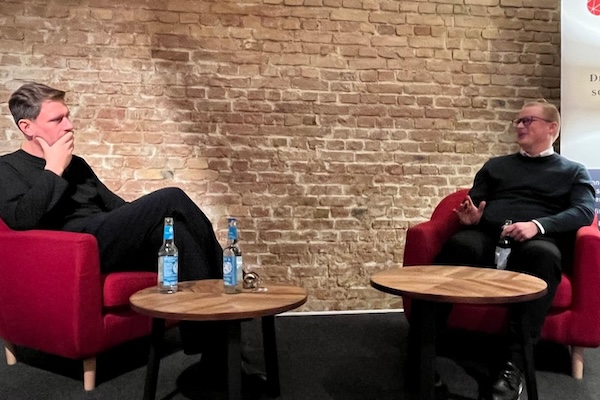
Guest:
Georg FAHRION, foreign editor at Der Spiegel, China correspondent from 2019 to 2025
Moderator:
Leonardo PAPE, freelance editor at China.Table, board member at German-Chinese Media Network
On March 15, the German-Chinese Media Network hosted a discussion with Georg Fahrion. Fahrion was China correspondent in Beijing for Der Spiegel from September 2019 until the end of 2025. Shortly after his return to Germany, Fahrion shared his thoughts on the social climate and political outlook in China.
Recounting China’s political and economic development during his time as a correspondent, Fahrion first reflected on the time of uncertainty in Chinese society at the outbreak of the pandemic. This was followed by a period of relative calm and triumphalism in relation to the West, as the number of Covid cases in China declined while it rose sharply elsewhere in the world. The bursting of the real estate bubble in 2021 led to deeper economic worries. For many, this was exacerbated on the social level, with epidemic control measures sometimes perceived as arbitrary and draconian throughout 2022.
During the ongoing sluggish post-pandemic economic recovery, Fahrion notes a co-existence of social moods in China. Challenges to make a living persist on an individual level; barely anyone in the common population would claim that the economy is going well. At the same time, there is a new degree of pride in China’s national strength and recognition as a powerful actor on the world stage, especially since China demonstrated its resilience in the trade conflict with the US.
German interlocutors frequently had asked him if criticism of central leadership policies (as during the pandemic handling) could also lead to broader protests. In his experience, however, especially older generations put current challenges into relation with previous times of upheaval, such as during the Cultural Revolution. In comparison, the present order would still be seen as rather stable and peaceful. Fahrion thus reiterated a conclusion that he had laid out in an essay for Der Spiegel in January, writing that China's social and political order is fundamentally stable.
Fahrion also shared thoughts on Germany’s China policy. In his view, the federal government’s stance on China under the chancellorship of Friedrich Merz is more unified than previously under Olaf Scholz, as the Chancellory and the Foreign Ministry now share a common policy outlook. Merz has pointed out systemic tensions and possible conflicts of interest between Germany and China more clearly than his predecessor. But up to now, Fahrion sees no coherent new policy strategy towards China spelled out.
Working as a correspondent, Fahrion perceived a general interest and curiosity among people in China. However, when receiving formal interview requests, caution has been on the rise. Foreign reporters do not face censorship in the way that Chinese media do, but are often followed and at times obstructed by officials while conducting investigations. WeChat conversations may be screened. Fahrion does not expect a significant loosening of domestic censorship or great improvements for foreign journalists' working conditions in the near future. Still, he emphasised that he saw the opportunity to work as a correspondent in China as a great privilege.